Industrial and Commercial Energy Storage BMS System Architecture
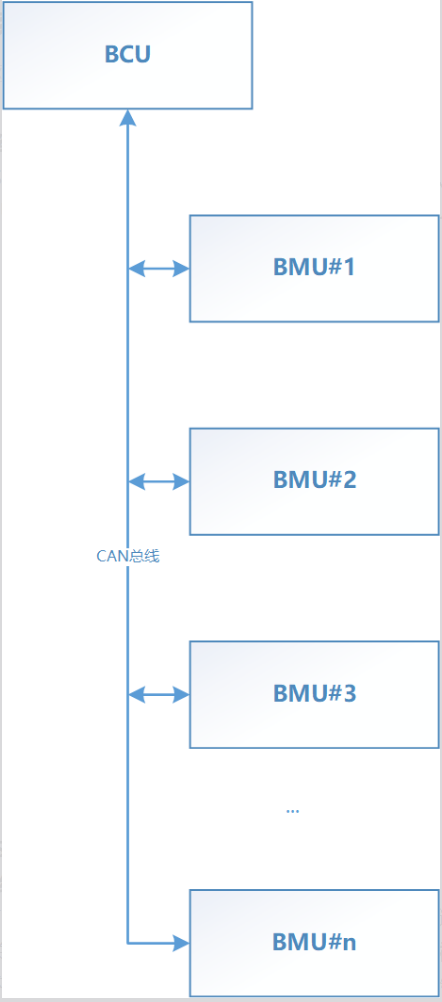
The industrial and commercial energy storage BMS generally adopts a two-level architecture, consisting of BCU and BMU respectively.
Among them, the BMU is responsible for data acquisition, while the BCU is responsible for data analysis, strategy decision-making and data reporting.
The BMU and BCU perform data interaction via CAN communication.
2. BMU Functions (The Nerve Endings of the BMS System)
As the "sensory nerve endings" of the battery pack, the BMU is mainly responsible for collecting the most original and accurate data. It monitors the voltage of each individual cell in real time. Through temperature sensors (usually thermistors) placed on cell surfaces, terminals or busbars, it collects temperatures at multiple key points inside the battery pack, including cell temperature and terminal temperature.
By implementing passive balancing (dissipating energy from high-voltage cells via resistors) or active balancing (transferring energy from high-energy cells to low-energy cells), the BMU equalizes cell voltages across the entire battery pack, improves overall pack energy utilization, and slows down battery life degradation.
3. BCU Functions (The Spine of the BMS System)
As the "spine" of the battery system, the BCU is mainly responsible for data processing, state estimation, logic control and external communication.
It performs SOC estimation and calibration using the ampere-hour (AH) integration method and OCV look-up table method, as well as SOH estimation and SOP estimation. The BCU ensures battery safety by notifying the PCS and EMS to limit power or actively disconnect DC contactors and circuit breakers when abnormalities are detected.
Related protection functions include:
Over-temperature and under-temperature protection
Excessive battery temperature difference protection
Battery over-voltage and under-voltage protection
System charge and discharge over-current protection
The BCU also conducts data interaction with the PCS and EMS, providing data support for the strategic scheduling of the EMS, which acts as the "brain" of the system.